Block by Block
The Sharon Woods Street Guide
The neighborhood does not read the same from one street to the next. Canopy, topography, lot depth, and traffic change block by block — and so does price.
Buyers arrive at Sharon Woods thinking about the neighborhood. Owners think about the street. The difference between a perimeter address on a connector and an interior address on a quiet bend is measurable — in noise, in canopy, in how children move around, and in resale.
This guide describes the neighborhood's streets by type rather than pretending every block is interchangeable. Use it alongside the interactive map, and walk the streets at two different times of day before you decide.
Perimeter and connector streets
The streets that carry Sharon Woods traffic to Sharon Road, Park Road, and Fairview do more work than the interior blocks. They see commuter volume in the morning and evening, and the houses fronting them price accordingly — typically a discount to a comparable interior house, sometimes a meaningful one.
This is not a reason to dismiss them. Perimeter houses often sit on the deepest lots in the neighborhood, back to tree lines, and offer the fastest exit to the SouthPark corridor. Buyers who work from home and rarely notice road noise behind a masonry wall and mature screening frequently find the best value in Sharon Woods on exactly these blocks.
- Higher traffic volume at commuting hours
- Frequently deeper lots and better rear screening
- A consistent price discount to interior comparables
- Best candidates for landscape-led sound mitigation
Interior residential streets
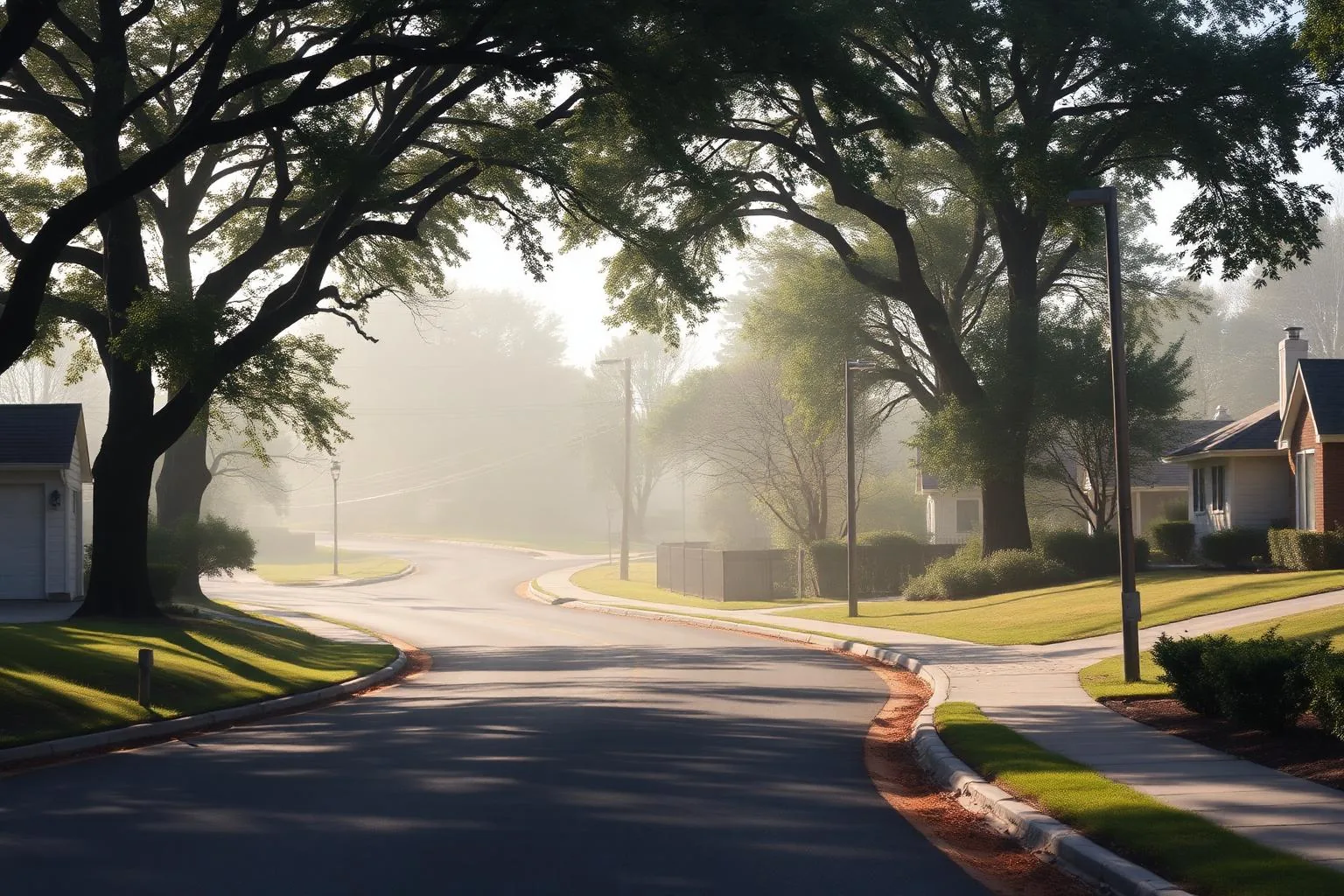
The interior of Sharon Woods is where the neighborhood does what it is famous for. Streets curve, sightlines close, the canopy meets overhead, and traffic is almost entirely people who live there. These blocks carry the neighborhood's strongest prices per square foot and its shortest days on market.
Character varies even here. Some interior streets sit level and open, with front lawns that read almost suburban. Others fall away toward the rear, producing walk-out lower levels, terraced back yards, and the split-level plans that define the neighborhood's mid-century core.
Cul-de-sacs and dead ends
The neighborhood's cul-de-sacs are its scarcest asset. Zero through traffic, pie-shaped lots that widen at the rear, and a social structure that forms almost automatically among six or eight households sharing one turnaround.
Expect these to trade at a premium and to be listed rarely. When a cul-de-sac house does come to market, it frequently sells to a buyer who has been tracking the street for a year or more.
Reading a street before you buy
Walk it twice — once at 8am on a weekday and once at 6pm. Note whether cars park on the street, whether sidewalks exist and where they stop, whether the canopy is continuous or has gaps from removals, and where water goes after a storm.
Then check the parcel data. POLARIS will show you lot dimensions, recorded easements, and floodplain overlays for the specific address. Charlotte's stormwater history is uneven across neighborhoods of this age, and a low corner lot behaves very differently from the house four doors up.
- Traffic and parking at two times of day
- Canopy continuity and any recent removals
- Sidewalk coverage and where it terminates
- Grade, drainage direction, and post-storm standing water
- Recorded easements and floodplain overlays on POLARIS
- Neighboring renovation activity and rebuild precedent
Street-Level Advice
The street is the asset. The house is the improvement.
Improvements can be bought. Location on the street cannot. Getting that ordering right is the single highest-leverage decision in a Sharon Woods purchase.
That work here is Peters & Associates — Sharon Woods Real Estate. Visit Peters & Associates
Affiliated or paid relationship; compensation never buys editorial placement. Full disclosure.
Go Deeper
Detailed pages in this section
Street Profile
Living on Sharon Road Frontage in Sharon Woods
The namesake edge road — traffic, deep lots, and where the value actually is.
ReadStreet Profile
Living on Park Road Frontage in Sharon Woods
The everyday-errand edge — closest to shopping, with the traffic to match.
ReadStreet Profile
Living on Fairview Road Frontage in Sharon Woods
The busiest boundary — where screening and setback do the most work.
ReadStreet Profile
Sharon Woods' Interior Residential Streets
Curving blocks, closed canopy, and the neighborhood's strongest prices.
ReadStreet Profile
Sharon Woods' Cul-de-Sacs and Dead Ends
Zero through traffic, pie-shaped lots, and homes that rarely come to market.
ReadStreet Profile
Sharon Woods' Perimeter and Connector Streets
The internal roads that funnel traffic to the edges — a distinct value tier.
ReadStreet-Level Fundamentals
Lot Sizes and Orientation Across Sharon Woods
Why shape, depth, and orientation matter more than the raw lot number.
ReadStreet-Level Fundamentals
Tree Canopy and Setbacks in Sharon Woods
The neighborhood's defining feature, and the rules that protect and constrain it.
Read
Questions & Answers
Frequently asked questions
Direct answers to what readers most often ask about this section of the guide. Each answer cites the primary source it rests on.
All Sharon Woods questions →Which streets in Sharon Woods are the most desirable?
+
Interior streets and cul-de-sacs carry the strongest pricing, because they combine minimal through traffic with the neighborhood's deepest canopy. Perimeter and connector streets typically trade at a discount but often offer the deepest lots.
Does Sharon Woods have sidewalks?
+
Sidewalk coverage is partial and varies block to block, which is typical of Charlotte neighborhoods platted in this era. Walk the specific street before assuming coverage, and check City of Charlotte records for any planned improvements.