Street Profile
Sharon Woods' Interior Residential Streets
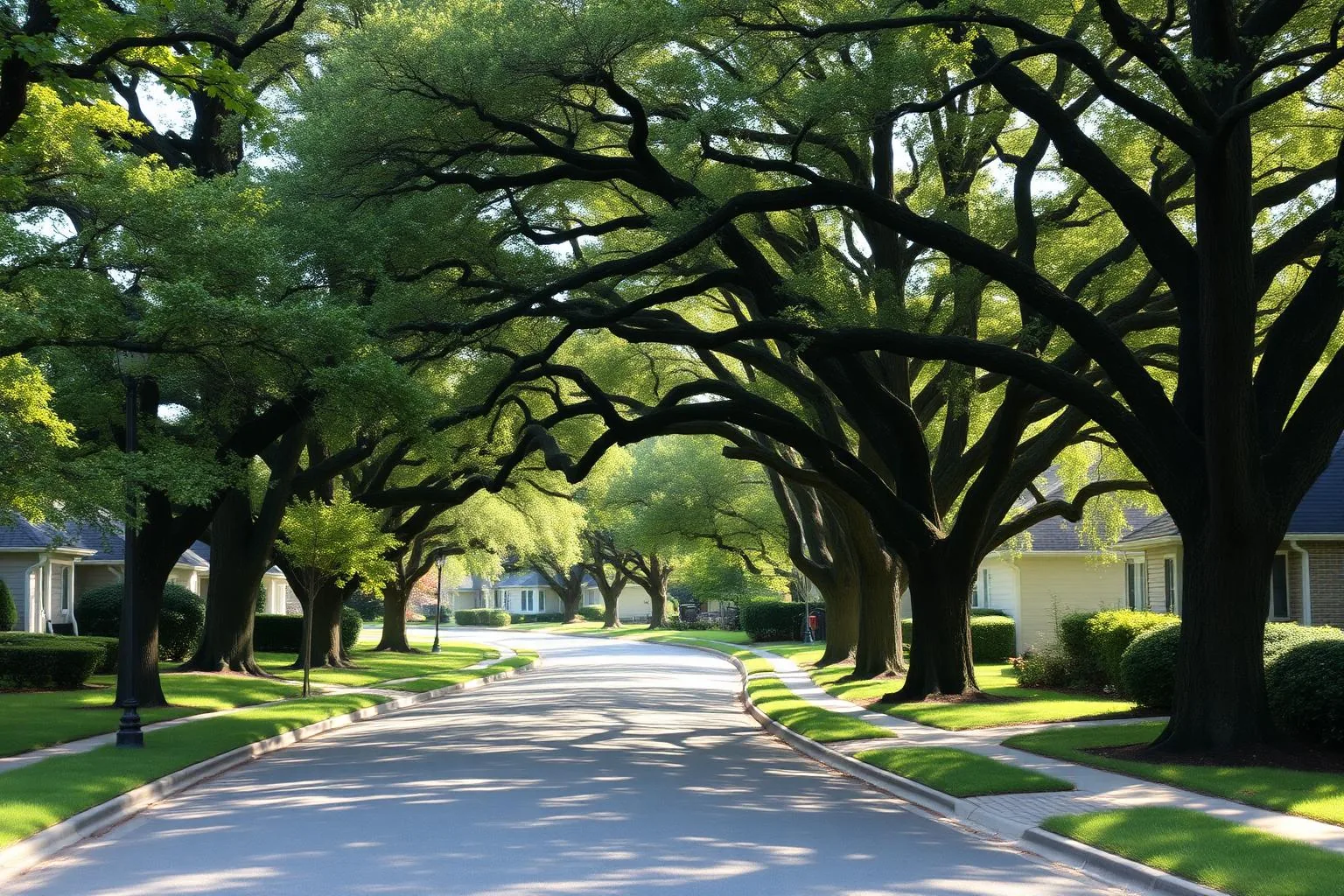
Where the neighborhood does what it is known for: curving blocks, closed canopy, and traffic that is almost entirely local.
| Traffic | Almost entirely residents and guests |
|---|---|
| Street pattern | Curving, not gridded |
| Canopy | Frequently closes overhead |
| Pricing pattern | Neighborhood's strongest per-square-foot values |
The interior of Sharon Woods is where the neighborhood's reputation is made. Streets curve rather than run straight, sightlines close within a block or two, and the traffic on them is overwhelmingly people who live there or are visiting someone who does. It is also where the neighborhood's strongest resale prices concentrate.
But 'interior' is not one experience. Some interior blocks sit level and open with front lawns that read almost suburban; others fall away toward the rear and produce an entirely different set of house plans and outdoor spaces.
What makes an interior street different
Curving streets were a deliberate design choice in the original subdivision, breaking from the straight grid of Charlotte's older streetcar neighborhoods and, not incidentally, slowing traffic naturally without requiring signage. Combined with the near-total absence of through-traffic, the result is a street environment where children genuinely play in front yards and cul-de-sacs, and where walking after dinner is unremarkable rather than notable.
The tree canopy compounds the effect. On the oldest and best-maintained interior blocks, mature hardwoods on both sides of the street meet overhead, producing a tunnel effect in summer that is one of the most photographed features of the neighborhood and a real driver of buyer preference.
- Curving street pattern that naturally moderates traffic speed
- Traffic that is almost entirely local, not pass-through
- Continuous canopy on the best-preserved blocks
- Front-yard and cul-de-sac play common for children
Level blocks versus falling blocks
Some interior streets sit essentially level, with lots that read flat from front to back and front lawns with a suburban, open character. These blocks tend to favor ranch and colonial house types and straightforward yard use — a swing set, a garden bed — without much grading complexity.
Other interior streets fall away toward the rear of the lot, sometimes considerably. These blocks produced the neighborhood's split-level housing stock and, on the steeper examples, terraced back yards and walk-out lower levels. See the split-level house-type page for how that plan responds to this exact topography.
- Level blocks: flatter lots, ranch and colonial plans, simpler yard use
- Falling blocks: split-levels, walk-out lower levels, terraced yards
- Grading and drainage differ meaningfully between the two patterns
- Both patterns exist across the interior — don't assume from one visit
What to check before buying on an interior street
Because the interior's biggest advantage — quiet, low traffic — is consistent street to street, the differentiators worth researching are canopy health, grade, and sidewalk presence, which vary block by block even within the interior. A tree that looks mature can still be in decline; ask about any recent removals nearby and what replaced them.
Lot dimensions, recorded easements, floodplain overlays, and setback rules are parcel-specific. Confirm any of it for a given address with the Mecklenburg County POLARIS viewer and Charlotte Planning, Design & Development before relying on it.
More in this section: Streets. Back to the full Sharon Woods guide.
Also in Streets
- Sharon Road Frontage
The namesake edge road — traffic, deep lots, and where the value actually is.
- Park Road Frontage
The everyday-errand edge — closest to shopping, with the traffic to match.
- Fairview Road Frontage
The busiest boundary — where screening and setback do the most work.
- Cul-de-Sacs & Dead Ends
Zero through traffic, pie-shaped lots, and homes that rarely come to market.
- Perimeter & Connector Streets
The internal roads that funnel traffic to the edges — a distinct value tier.
- Lot Sizes & Orientation
Why shape, depth, and orientation matter more than the raw lot number.
- Tree Canopy & Setbacks
The neighborhood's defining feature, and the rules that protect and constrain it.
Street-Level Advice
The interior is not one product — walk more than one block
A level interior lot and a falling interior lot produce entirely different houses and yards. See both before deciding which suits your household.
That work here is Peters & Associates — Sharon Woods Real Estate. Visit Peters & Associates
Affiliated or paid relationship; compensation never buys editorial placement. Full disclosure.
Questions & Answers
Frequently asked questions
Direct answers to what readers most often ask about this section of the guide. Each answer cites the primary source it rests on.
All Sharon Woods questions →Are all interior streets in Sharon Woods the same?
+
No. Traffic and quiet are consistent across the interior, but topography varies considerably — some blocks sit level and open, others fall toward the rear and produced the neighborhood's split-level housing stock. Walk more than one interior street before assuming they are interchangeable.
Why do interior streets in Sharon Woods command higher prices?
+
Low through-traffic, mature closed canopy, and a curving street pattern that slows cars naturally combine to make the interior the neighborhood's most sought-after location, which shows up directly in price per square foot and shorter time on market.
Do interior streets have sidewalks?
+
Sidewalk coverage varies by block and is not consistent across the interior. Walk the specific street being considered and note where sidewalks exist and where they stop before assuming pedestrian access.